
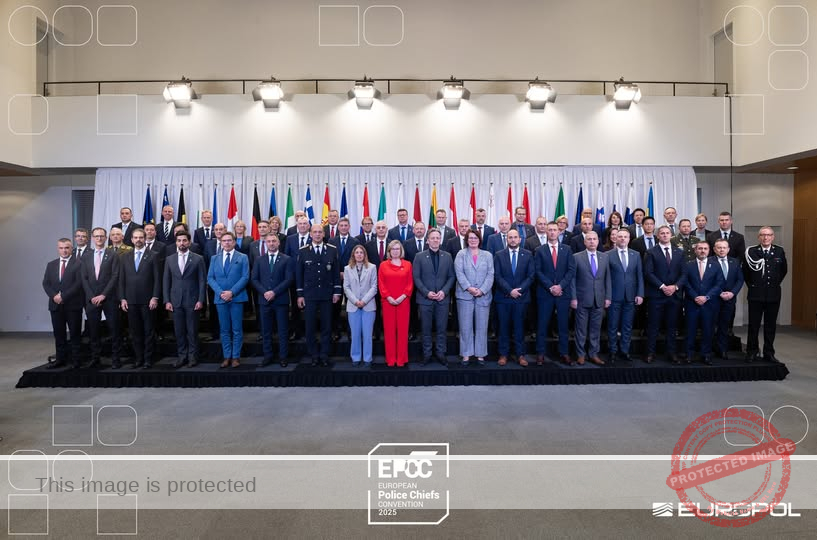
This week, more than 400 police chiefs and senior law enforcement officials from 53 countries and 13 international organisations came together at Europol’s headquarters in The Hague for the European Police Chiefs Convention (EPCC) 2025. The annual event provided a platform for global law enforcement leaders to discuss critical security challenges facing Europe and explore strategies to combat emerging threats.
What Happened
The conference opened with remarks from Catherine De Bolle, Europol’s Executive Director, and Lene Steen, Deputy National Commissioner of the Danish Police. Keynote addresses followed from Magnus Brunner, the EU Commissioner for Internal Affairs and Migration, Beate Gminder, Director General for Migration and Home Affairs at the European Commission, and Gerassimos Thomas, Director General for Taxation and Customs Union at the European Commission.
Throughout the event, attendees participated in two pivotal panels that highlighted how criminals are increasingly exploiting digital technologies for violent and financial crimes. These panels focused on Crime-as-a-Service and the use of digital financial systems by criminal networks.
Who Was at the Event
The event brought together senior law enforcement leaders from across Europe and beyond. Notable participants included police chiefs, representatives from national customs administrations, as well as experts from key international partners. The aim was to strengthen international cooperation and share insights into modern law enforcement techniques and strategies for tackling digital crime.
Key Discussions: Tackling Emerging Threats
Crime-as-a-Service: Minors Targeted by Online Criminal Networks
One of the key issues discussed during the Crime-as-a-Service panel was the alarming rise of minors being drawn into criminal networks through online gaming, social media, and encrypted channels. The panel discussed the phenomenon of Violence-as-a-Service, where acts of intimidation or assault can be contracted through the internet. Police leaders emphasized the need for:
- Centralised, specialised investigative structures to track online recruiters and enablers.
- Stronger preventive measures to protect vulnerable youth online, including educational campaigns and school engagement.
- Enhanced international cooperation and data sharing powered by AI to identify criminal networks more swiftly.
- Regulatory obligations for gaming platforms and social media to protect minors and cooperate with law enforcement.
Follow the Money: Digital Finance Exploited by Criminals
The Follow the Money panel examined the exploitation of digital financial services by criminals involved in organised crime, cybercrime, and terrorist financing. Key challenges identified during the discussion included:
- The rapidly evolving criminal techniques that outpace law enforcement’s investigative capabilities.
- A shortage of specialists and costly tools for tracing blockchain and cryptocurrency transactions.
- Obstacles in cross-border investigations, particularly in safe-haven jurisdictions with weak Anti-Money Laundering (AML) standards.
Solutions proposed included:
- Joint investigative “sprints” to trace and seize criminal assets across borders.
- Pooling resources for blockchain and crypto analysis tools and increasing training investment.
- Treating money laundering as a stand-alone offence to speed up prosecutions.
- Strengthening public-private partnerships for better information sharing and early warning systems.
Strengthening Europe’s Security Architecture
The 14th edition of the EPCC served as an important venue for strategic discussions on the future of Europol and European security cooperation. The conference also hosted the Meeting of the Directors General of Customs Administrations, where customs leaders exchanged best practices and coordinated on cross-border threats.
Recognising Innovation in Law Enforcement
A highlight of the event was the presentation of the Europol Excellence in Innovation Awards, recognizing outstanding initiatives that have creatively tackled emerging threats such as digital crime, financial crime, and the protection of vulnerable populations. This year, law enforcement agencies from Portugal, Germany, and Norway were honoured for their contributions in the following categories:
- Ethics
- Diversity & Inclusion
- Innovative Operation
- Technical Innovation
What Happens Next
The European Police Chiefs Convention continues to serve as a vital forum for strengthening operational cooperation among European law enforcement agencies and their international partners. As criminal threats evolve, the event reinforced the importance of international collaboration, data-sharing, and innovative policing in maintaining Europe’s security.
As the discussions wrap up, Europol is expected to continue focusing on advancing tools, strategies, and partnerships to address emerging threats in a rapidly changing digital landscape.
This story may be updated with more information as it becomes available.
