
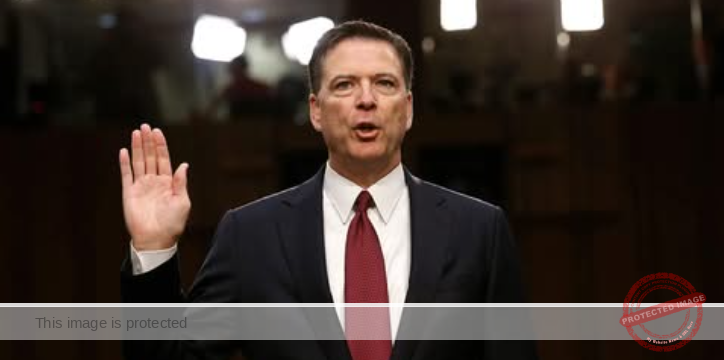
James Comey, the former FBI Director, appeared in court on Wednesday in Alexandria, Virginia, where he pleaded not guilty to charges of making false statements and obstruction during a congressional investigation. Comey’s charges stem from his involvement in the FBI’s handling of the Trump-Russia investigation, a case that has attracted significant public and legal attention.
What Happened:
On October 4, 2025, James Comey faced charges in federal court following his involvement in the controversial “Crossfire Hurricane” investigation. The indictment alleges that Comey made false statements during his testimony before Congress in 2020 and obstructed the investigation by providing misleading information about his role in the FBI’s handling of sensitive information. Specifically, Comey is accused of falsely denying his authorization for an anonymous source at the FBI. Additionally, the obstruction charge relates to Comey’s alleged attempts to hinder the progress of the congressional investigation into the FBI’s handling of the Trump-Russia probe.
During the court hearing at the Albert V. Bryan United States Courthouse, Comey, accompanied by his legal team, entered a plea of not guilty. His lawyer, Patrick Fitzgerald, voiced that representing Comey was an honor, while also indicating plans to challenge the charges as politically motivated. The judge set dates for oral arguments in November and December, with a trial scheduled for January 5, 2026.
Who Was James Comey:
James Comey is best known for his tenure as the FBI Director, a role he held from 2013 until his firing by President Donald Trump in 2017. Throughout his career, Comey has been involved in pivotal moments in American political history, most notably the investigation into Hillary Clinton’s emails and the Trump-Russia probe. His dismissal from the FBI by Trump in 2017 became a significant event that ultimately led to the appointment of Robert Mueller as Special Counsel to investigate Russian interference in the 2016 U.S. Presidential Election. Comey’s testimony before Congress in 2020 regarding his handling of the investigation into Russian interference is central to the charges now faced by the former FBI Director.
While his tenure at the FBI was controversial, Comey has maintained his stance that his decisions were made in accordance with the law. In the wake of his dismissal, Comey published a memoir, “A Higher Loyalty,” which chronicled his experiences within the FBI, his role in the Trump-Russia investigation, and his relationship with President Trump.
Career, Legacy, and Case Details:
Comey’s career has been marred by highly scrutinized decisions, particularly his handling of the Clinton email investigation and his role in the Trump-Russia probe. His firing by Trump led to a wave of political controversy, particularly as it related to the investigation into Russian interference in the 2016 election. Special Counsel Robert Mueller’s investigation, which concluded in 2019, found no evidence of criminal conspiracy between the Trump campaign and Russian officials, though it did outline several instances of potential obstruction by President Trump.
The ongoing investigation into Comey’s alleged misconduct focuses on whether he misled Congress about his role in these matters. The recent charges have reignited debates about the FBI’s actions during the 2016 election and the handling of politically sensitive investigations.
Public and Social Media Reactions:
The public’s reaction to Comey’s legal troubles has been divided. Some view the charges as an attempt to undermine Comey’s previous testimony and tarnish his legacy. Others, especially President Trump’s supporters, argue that Comey’s actions were part of a larger effort to undermine the Trump administration. On social media, people have expressed their views with varying opinions, ranging from supporting Comey’s stance on the investigations to criticizing his role in what some consider political interference.
Attorney General Pam Bondi, in a statement following the indictment, remarked, “No one is above the law,” highlighting the department’s commitment to holding individuals accountable for abuse of power. FBI Director Kash Patel added that Comey’s actions were part of a broader issue within the agency during the Trump-Russia probe, underscoring the need for justice.
Official Statements or What Happens Next:
After the hearing, Comey was released on his own recognizance, meaning he does not need to be detained while awaiting trial. The case will continue with the motions to be filed by Comey’s legal team, including claims of retaliatory prosecution and grand jury abuse. The legal process will unfold over the coming months, with the first oral argument scheduled for November 19, 2025.
Closing Line:
This story may be updated with more information as it becomes available.
