
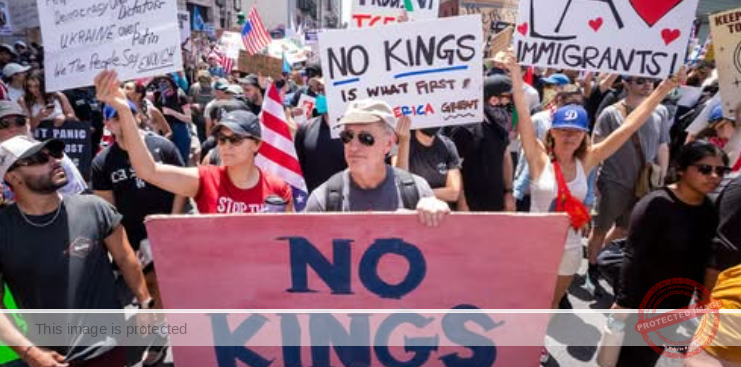
Millions of Americans participated in the “No Kings” rallies across the country last Saturday, according to The New York Times, protesting President Donald Trump’s leadership, which they view as monarch-like. However, the very success of these protests raises questions about the nature of the dissatisfaction — especially when it seems to clash with the policies that Trump has enacted and that many Americans support.
The “No Kings” Protests and Their Messaging
Originally advertised as a march from Whitechapel Station, the demonstration was later revised to an assembly in the same area, organized by the United Kingdom Independence Party (UKIP) as part of their “mass deportations tour.” The protests were touted as a “crusade” calling for the reclaiming of areas from what they deemed “Islamists.” They featured a substantial counter-protest from groups like Stand Up To Racism, with tensions running high.
In London, the protest organizers described it as an effort to “reclaim Whitechapel,” and crowds rallied behind this mission, calling for changes to policies that, according to them, threaten their ideals of justice. The protests were filled with energy and passion. But the truth is, a monarch would have tried to suppress these demonstrations, not simply allow them to unfold.
The political reality, however, shows that the protests appear fueled by labor unions, such as the American Federation of Teachers (AFT), which boasts nearly 3 million members, and the AFL-CIO, with a membership of 15 million. This surge of collective action might be seen as driven more by organized efforts to challenge the system rather than spontaneous grassroots activism.
Addressing Concerns About Trump’s Policies
So, what exactly has stirred up such animosity toward President Trump’s leadership? Why do these “No Kings” protests persist when so many of Trump’s policies appear to have widespread support?
- Cracking Down on Drug Cartels: Trump’s policies to combat the influx of fentanyl and other deadly substances have helped curb the flow of these drugs into the U.S., despite the critics’ claims of overreaching.
- Securing the Southern Border: The administration’s approach to securing the U.S.-Mexico border and limiting undocumented immigration has found broad support, especially in border states.
- Trimming Federal Bureaucracy: Trump’s efforts to reduce the size and spending of the federal government have resonated with a large swath of Americans, even as critics complain about the rollback of regulations.
- Education Reform: Trump’s attempts to revolutionize education, particularly through measures targeting Black and brown students who are failing to meet educational benchmarks, have found favor with many, even as they are criticized by others.
- Crime Reduction: Trump’s policies aimed at controlling crime in cities like Chicago and New York have broad public support, yet his critics remain vocal.
- International Diplomacy: Trump’s diplomatic efforts, such as securing a fragile ceasefire between Israel and Hamas, bringing hostages home, and curbing Iran’s nuclear ambitions, have garnered positive responses, even from some factions of his political opposition.
- Reviving U.S. Manufacturing: President Trump’s efforts to bring manufacturing jobs back to the United States have drawn applause from labor unions that stand to benefit from these changes, contrary to what might be expected from his critics.
The Real Bone of Contention: Exposing Corruption
Perhaps what riles critics the most is Trump’s willingness to expose the pervasive corruption within the Democratic Party. Alongside tech mogul Elon Musk, Trump has unveiled the web of taxpayer-funded NGOs supporting left-leaning causes, often funded by billionaires whom politicians like Bernie Sanders denounce. These revelations have not only highlighted the financial networks at play but also raised questions about the influence of these groups on the political landscape.
Additionally, Trump’s aggressive stance on investigations into the Russiagate affair, media censorship, and the misuse of federal resources for partisan purposes has put his critics on the defensive.
A Leadership Style that Resists Control
What has frustrated the Democrats further is that, despite all the legal challenges, investigations, and millions of dollars spent to undermine Trump’s presidency, he remains in power. His resilience, despite the efforts to tarnish his image, has only fueled further anger from the left.
Trump’s policies, such as opposing transgender athletes in women’s sports and banning DEI programs, reflect his alignment with mainstream American values, which only deepens the divide.
Conclusion: The Growing Divide and Calls for Transparency
While President Trump’s policies have undeniably garnered significant public support, it’s his commitment to exposing the corrupt political system and his ability to endure relentless legal and political attacks that have sparked this deep divide. As President Trump himself stated, “I’m not a king, I work my a– off to make our country great.”
What is really making Democrats anxious is not just Trump’s unyielding approach to governance, but his willingness to confront the realities of corruption and the status quo, putting a spotlight on the very forces that have maintained control for so long.
In the face of opposition, Trump continues to push forward. As the country moves toward election season, it is clear that the battle lines are drawn, and the outcome will be determined by the American people.
