
Portland, Oregon — In a federal bench trial that could have significant implications for the balance of power between federal and local law enforcement, Portland Police Bureau Commander Franz Schoening testified on Wednesday that federal forces deployed to control protests outside a U.S. Immigration and Customs Enforcement (ICE) facility had exacerbated tensions and violence rather than diffusing them.
The trial, which examines whether President Donald Trump had legal grounds to send in the National Guard to Portland, is ongoing. Local city officials have argued that the federal intervention was unnecessary and inflammatory, further escalating protests rather than maintaining order.
What Happened: Federal Forces Escalate Tensions
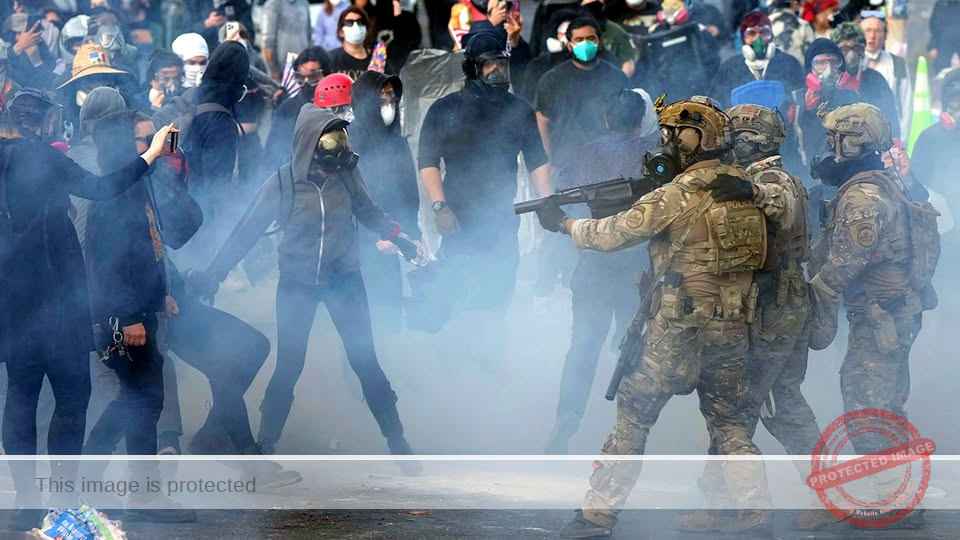
Commander Schoening, who has been involved in the management of protests in Portland, described instances in which federal agents deployed tear gas at what he referred to as largely nonviolent demonstrators. These actions, he testified, were “startling” and seemed to intensify the unrest rather than calming the situation.
The protests at the ICE facility had been ongoing since June, with activists demonstrating against federal immigration policies. Schoening testified that federal officers used tactics, such as tear gas and other munitions, that Portland police are prohibited from using under state and federal law. He said that Portland officers were themselves hit by tear gas, forcing them to retreat from the scene.
One significant incident, recounted by Schoening, took place on October 18 during a large protest when a federal agent allegedly launched a munition — either smoke or tear gas — which bounced off the facility’s driveway and landed on the roof, where other federal agents were stationed. In response, the agents fired additional rounds into the crowd. Schoening emphasized that the protests had been largely peaceful, with no violent conduct to justify the force used by federal agents.
“We didn’t see any violent conduct or behavior that would have precipitated that use of force,” Schoening testified. “It appeared to be triggered by the federal officer’s deployment of that munition. Our officers were in close proximity and were struck by federal munitions.”
Who Was Affected and the Broader Legal Context
The case centers around whether the federal government had the legal right to deploy the National Guard and federal agents to Portland. Portland’s legal team, including attorney Caroline Turco, argued that the protests were mostly nonviolent, and that the actions of the federal government were an overreach. “This case is about whether we are a nation of constitutional law or martial law,” Turco stated in her opening remarks.
The U.S. Department of Justice (DOJ) countered that federal personnel had been targeted by violent protests throughout the summer. DOJ attorney Eric Hamilton argued that “agitators have used violence and threatened violence” against officers and property, suggesting that the deployment of federal agents was necessary to restore order.
The Trump administration has argued that federal agents had to be deployed because of Portland’s failure to provide adequate support to federal officers. DOJ attorneys also claimed that the Trump administration’s decision to call in the National Guard was legally justified under federal law, citing the “danger of rebellion” and the need for the National Guard to maintain peace.
Public Reaction and Ongoing Investigation
The trial has sparked widespread debate over the use of federal forces in local protests and the limits of federal authority. Local police in Portland have maintained that they have been responsive to protests, making arrests when necessary while still respecting the First Amendment rights of the demonstrators.
The non-jury trial, which is expected to last three days, will include testimony from both federal officials and local police. The outcome of the trial could set important precedents for how future protests are managed and how federal authorities can intervene in local matters, especially when the protests are seen as threatening public safety.
As of now, the trial continues, and the community, including both local and federal officials, anxiously awaits a ruling on the matter.
This story may be updated with more information as it becomes available.
