
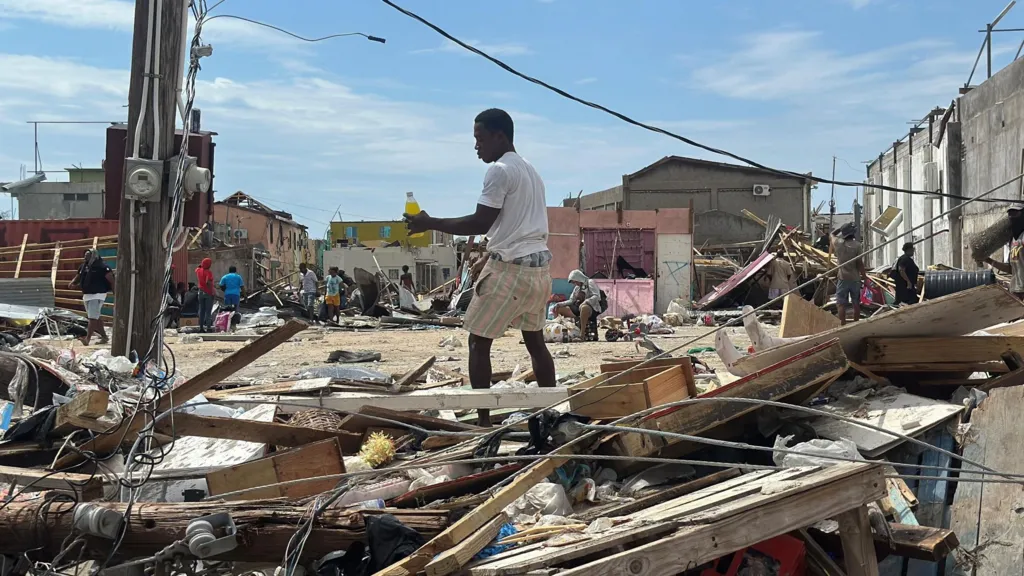
Residents of Black River, Jamaica, are in a state of devastation and desperation as they search for food, water, and missing loved ones, days after Hurricane Melissa—one of the most powerful Category 5 storms ever recorded in the region—struck the city. The storm has caused catastrophic damage, leaving roads impassable and infrastructure destroyed, with aid still struggling to reach the hardest-hit areas.
What Happened:
Hurricane Melissa made landfall in Black River on [insert date], battering the coastal town with fierce winds and a destructive storm surge that left almost everything in its path obliterated. In the aftermath, local residents are scavenging the wreckage for food and supplies. As the death toll rises, at least 19 people in Jamaica and 30 in neighboring Haiti have been confirmed dead. Many more remain unaccounted for, as roads are impassable and communication systems are down.
On the ground, the situation is grim. Buildings are crumbled, boats have capsized along the roadside, and debris from destroyed structures litters the streets. The residents of Black River, who were already struggling before the storm, are now facing an even more dire reality: no electricity, no running water, and a lack of basic necessities.
Desperate Survival Efforts
Survival has become the primary concern for many in Black River. With no aid trucks in sight and little outside assistance, residents have resorted to looting supermarkets and pharmacies. Many have climbed onto partially destroyed buildings to retrieve food, water, and essential supplies, tossing them down to others waiting below. “We didn’t be selfish, we had to throw food to other people,” Demar Walker, a local resident, explained as he sat in the shade to escape the oppressive heat and 80% humidity.
Looting has been widespread. Aldwayne Tomlinson recounted seeing a pharmacy being ransacked, with people running in and out carrying armfuls of drugs and alcohol. “At first, I thought the place was still open,” Tomlinson said. “But then I really got a second glance. I heard a lady say, ‘Mi need go get some alcohol.’ That’s when I knew they were looting.”
Rising Tensions and the Impact of the Storm
The storm’s devastation has left local infrastructure in ruins. The Black River police station, fire station, and hospital are all severely damaged, adding to the growing sense of isolation and fear. A local medic, Michael Tharkurdeen, described the flooding that occurred at the fire station, where waters reached up to five feet high. “Nobody could be on the bottom floor. Trust me, there were waves there about this high,” he said, pointing to his shoulder. People who arrived at the station after the waters receded were in poor condition, with many suffering from lacerations, and some were found lifeless.
Residents, like Chegun Braham, have described the chaos: “No food. No water. We don’t have access to money. We need help. No help has come.” As people fight for survival, the atmosphere in Black River is one of utter despair, with many fearful they may not survive without immediate aid.
Efforts to Get Aid to Black River
As local officials scramble to assess the damage, they note that 90% of the homes in Black River have been destroyed. Despite the mounting desperation, aid supplies have been slow to arrive. While the main airport in Kingston is starting to see relief flights, smaller regional airports remain only partially operational. The main roads to Black River are flooded and clogged with vehicles, further delaying essential supplies from reaching the community.
On Friday, a fleet of military helicopters arrived, bringing a glimmer of hope to the overwhelmed town. Armed officials descended onto the streets, dispersing crowds and clearing the blocked roads. The arrival of these helicopters marks a critical point in the delivery of aid, as people cling to the hope that food, water, and medical supplies will soon follow.
Mayor and Community Reactions
The Mayor of Black River, Richard Solomon, expressed understanding of the looting, acknowledging the community’s desperation. “It is a delicate balance,” he said. “Persons are seizing the opportunity to pick up what they can off the ground. However, you have others being a little bit more forceful, where they are trying to get into people’s properties to get all sorts of supplies.”
As authorities continue to work on clearing the blocked roads and organizing the distribution of aid, local residents like Shawn Morris are holding onto hope. “St Elizabeth, we want it to come back again,” he said, emphasizing that the community’s survival is the priority. “It’s not about the money. We need food and water.”
Closing Line:
This story may be updated as more information becomes available regarding aid efforts and recovery efforts in Black River.
