
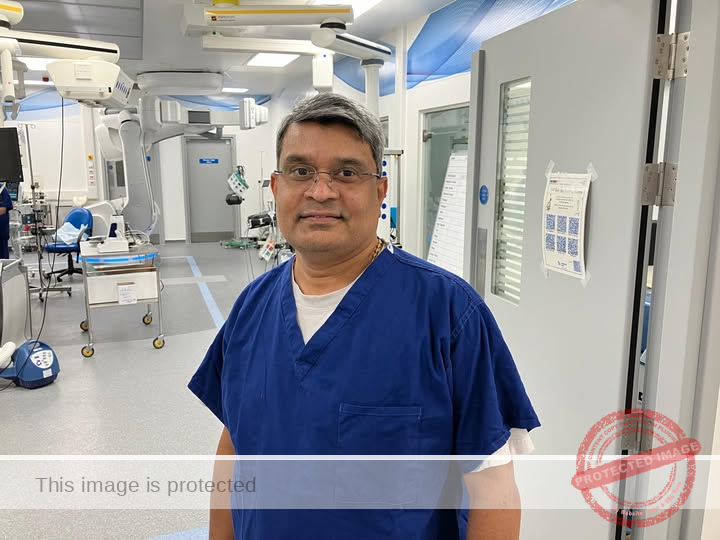
A pioneering procedure at the University Hospitals of Leicester NHS Trust (UHL) has made European medical history, offering new hope to patients with chronic foot ulcers and poor circulation. Led by Dr. Badri Vijaynagar, Consultant Vascular and Endovascular Surgeon, the innovative surgery used two resorbable scaffolds to restore blood flow to the foot of 90-year-old John Atton, marking a significant breakthrough in vascular care.
The Groundbreaking Procedure:
The operation took place at Glenfield Hospital, where a specialized team of vascular experts performed a procedure using two resorbable (dissolving) scaffolds. These scaffolds temporarily support the artery, opening it to allow blood to flow more freely. This marks the first time in Europe that such a procedure has been successfully carried out. The scaffolds gradually dissolve, allowing the artery to function naturally without leaving a permanent metal stent.
This technique has already been trialed in the United States, with promising results in improving circulation and promoting wound healing in patients suffering from severe below-knee artery disease. The procedure offers a non-invasive solution for patients who suffer from chronic conditions like Chronic Limb-Threatening Ischaemia (CLTI), a serious disease that can cause pain, infection, and even lead to amputation.
John Atton’s Journey:
The procedure was performed on John Atton, a 90-year-old patient who had been struggling with an ulcer on his foot for over a year. Despite regular treatments and dressings, the ulcer had failed to heal due to poor circulation caused by CLTI. “I’ve had the ulcer for well over a year, and it’s been very painful, particularly at night. When we were told about this new procedure, I was hopeful that it might finally help my foot to heal,” said John.
The surgery was performed under local anaesthetic, and John was able to return home shortly after the operation. He will follow up with his doctors at Glenfield Hospital as the scaffolds continue to dissolve, improving his circulation and healing the wound.
A New Era in Vascular Care:
Dr. Badri Vijaynagar, who led the surgery, expressed his pride in the procedure’s success. “This is the first time in Europe that two resorbable scaffolds have been placed in the artery. The technique allows us to restore blood flow without leaving a permanent metal stent behind,” Dr. Vijaynagar explained. “Over time, the scaffolds dissolve, and the artery functions naturally again.”
The procedure provides new hope for patients with chronic wounds, especially those with diabetes or peripheral arterial disease. By improving circulation to the foot and lower leg, it enhances the healing process, reduces the risk of infection, and significantly improves comfort and mobility.
“We’re proud to have performed this groundbreaking procedure for the first time in Europe. It’s a proud moment for our team and for vascular care in the UK,” Dr. Vijaynagar added.
Looking Ahead:
John Atton’s recovery marks a hopeful future for patients who have struggled with chronic wounds and poor circulation. The successful use of resorbable scaffolds opens doors to innovative treatments for those suffering from vascular diseases, and it represents a significant step forward in non-invasive medical procedures.
Closing Line:
The success of this procedure in Leicester sets a new standard for vascular care, and as more patients benefit from this innovative treatment, it promises to change the way we approach chronic limb and wound care across Europe.
