
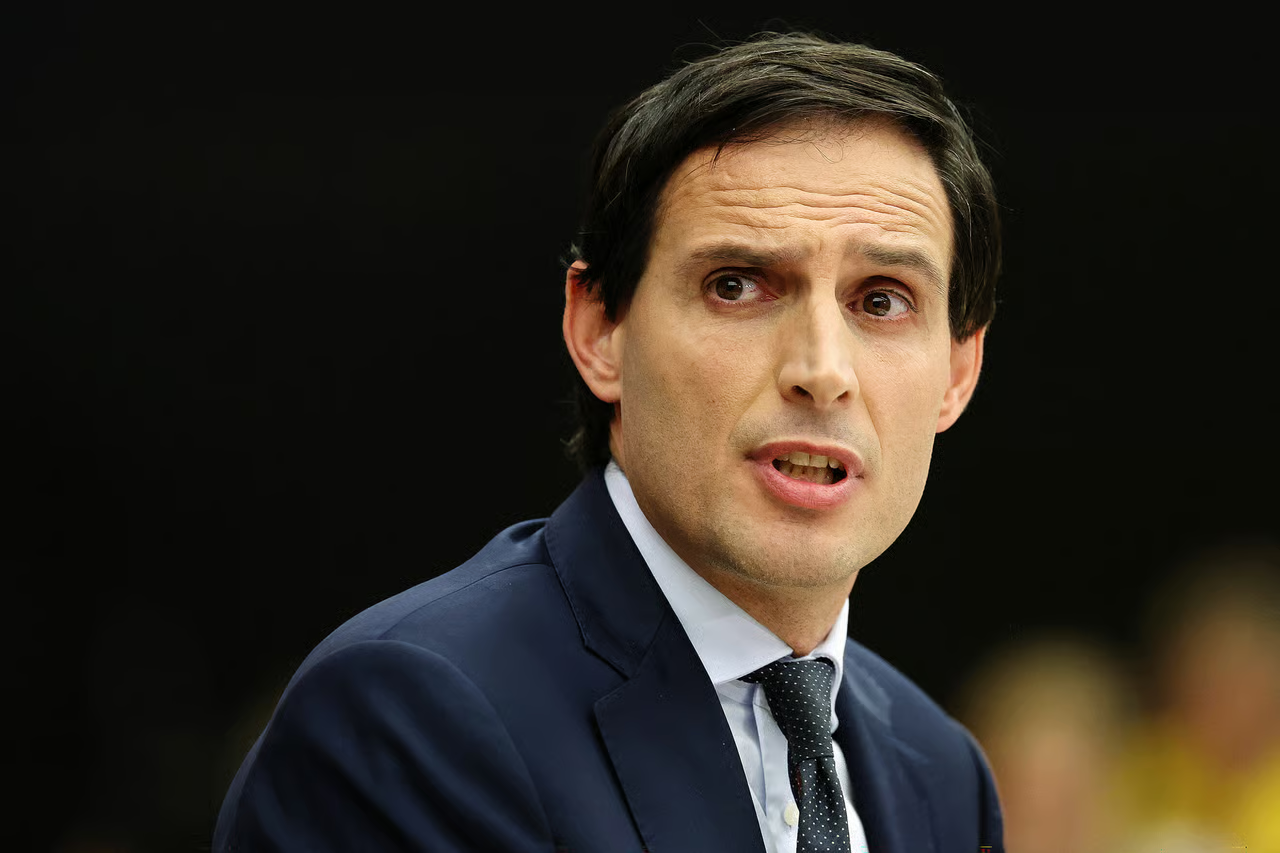
WASHINGTON D.C. — The United States’ decision to skip high-level representation at the forthcoming COP30 climate summit in Belém, Brazil, from Nov. 10, 2025, has been described as a “watershed moment” by Wopke Hoekstra, the European Union’s Climate Commissioner. His stark warning highlights what he sees as a major setback in global climate efforts.
What Happened
The White House confirmed that the U.S. will not send senior officials to COP30, marking a sharp departure from previous years where the U.S. delegation included cabinet-level officials or heads of state.
Hoekstra warned that the absence of the U.S., the world’s second-largest emitter of greenhouse gases, sends a troubling signal to the rest of the international community. “If a player of that magnitude basically says, ‘Well, I’m going to leave and have it all sorted out by the rest of you,’ clearly that does damage,” he told reporters.
The decision comes as roughly 100 countries still have not submitted upgraded climate targets ahead of COP30, and key participants such as China are also facing criticism for low emissions-reduction commitments.
Background and Context
COP30 is scheduled to be held in Belém, Brazil, later this month. The summit is expected to set the agenda for climate action through 2030 and beyond, including issues like adaptation funding, carbon-market mechanisms, and global cooperation on fossil-fuel phase-out.
Under the leadership of Donald Trump, the U.S. has already announced plans to exit the Paris Agreement — the second time the country has formally withdrawn — and has opposed recent global efforts such as a proposed carbon-emissions fee for international shipping.
Significance and Stakes
Experts say the U.S. absence at COP30 could reduce momentum for systemic change. Hoekstra argued that without American leadership or involvement, reaching consensus on vital issues like adaptation finance and carbon-market integrity could be far harder.
Nevertheless, some U.S. state and local governments are still expected to attend, highlighting a divide between federal policy and sub-national climate action. The question remains: can global climate efforts stay on track without the full participation of the U.S.?
Public and International Reactions
Global leaders and climate advocates have reacted with concern. Many see the U.S. absence as a blow to multilateral cooperation on climate change. One diplomat noted that such a major player “sitting out” could weaken the entire summit’s credibility.
On social media, hashtags like #COP30 and #USclimatepolicy are trending, with users from civil-society groups calling the move a “reckless retreat.” Meanwhile, European officials reiterate their commitment even as they express disappointment over the U.S. stance.
What Happens Next
Countries attending COP30 will proceed with negotiations beginning Nov. 10 in Belém. Key topics include enhanced emissions targets (known as NDCs), adaptation finance, and a potential new global carbon-market architecture.
For the U.S., the decision may trigger diplomatic fallout and could prompt greater efforts by other major emitters to fill the leadership vacuum. Observers will closely monitor whether the absence leads to weaker outcomes or galvanizes remaining nations to adopt more ambitious goals.
This story may be updated with more information as it becomes available.
