
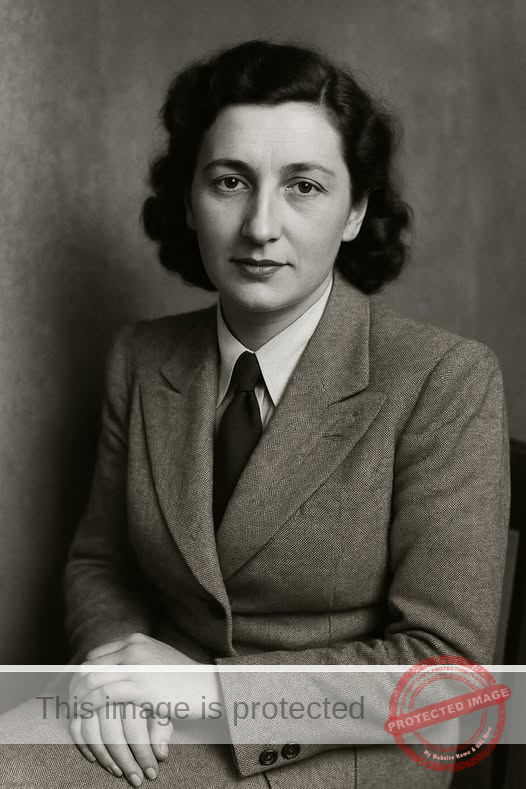
In the shadows of Nazi-occupied France, one woman’s bravery and intelligence network helped turn the tide of World War II. Marie-Madeleine Fourcade, a 31-year-old mother, led the Alliance, one of the largest and most successful intelligence networks of the French Resistance. Her story, filled with courage, sacrifice, and perseverance, remains a testament to her legacy in shaping the Allied victory.
What Happened
In 1941, as Nazi forces occupied France, Marie-Madeleine Fourcade became the leader of the Alliance network, taking a position no woman had previously held — as the head of a vast intelligence organization. Her network was directly linked with MI6, Britain’s intelligence service, providing critical information for the Allied war effort. From V-1 and V-2 rocket sites to German troop movements, Fourcade’s team supplied invaluable intelligence, and her leadership proved instrumental in the successful execution of the D-Day invasion.
The Alliance’s work was highly dangerous, and as its leader, Fourcade was continuously at risk of capture. Yet she was known for her resilience, and despite being captured twice by the Gestapo, she escaped both times and returned to the field to lead her agents from the shadows.
Who Was Marie-Madeleine Fourcade / Background of the Case
Born in 1911 in France, Marie-Madeleine Fourcade was a determined and intelligent woman long before the war began. Her work with the French Resistance started in 1940, when she joined the Alliance network, but she quickly proved herself as a capable leader. The network’s codename for her was “Hérisson,” meaning hedgehog, a symbol of her unassuming yet formidable nature. Under her leadership, Alliance grew to include more than 3,000 agents across occupied France, providing critical intelligence that shaped the outcome of the war.
In her early thirties, Fourcade became one of the most influential figures in the French Resistance. She led her agents through clandestine operations, often coordinating across Europe. Despite the risks, she never hesitated to act, often putting herself in harm’s way to ensure the success of her network’s missions.
Career, Legacy, and Contributions
Marie-Madeleine Fourcade’s work in WWII was invaluable to the Allied war effort. The information her network provided was instrumental in thwarting Nazi operations and gathering intelligence for major battles, including the D-Day landings. Her network was also responsible for providing key information about the German war machine, including V-1 and V-2 rocket sites, which would later be targeted by Allied forces.
Fourcade’s bravery was not just evident in her intelligence work but also in her personal courage. After being captured by the Gestapo in 1944, she found herself in a prison cell in Aix-en-Provence. Faced with near-certain death, she escaped by stripping naked, covering herself in sweat, and squeezing through the iron bars of her cell window, disappearing into the night. She quickly returned to contact her agents and continued her leadership efforts until the war’s end.
Her contributions to the war were immense, and despite the sacrifices, Fourcade’s Alliance network helped secure vital victories. Her leadership helped foster a sense of hope among the French Resistance and showed the Allies that resistance, no matter how daunting, could succeed.
Public and Social Media Reactions
Marie-Madeleine Fourcade’s story has been celebrated in recent years as a testament to her bravery, intellect, and leadership. Though she was one of the most important figures in the French Resistance, her achievements were long overshadowed by others. However, in the modern era, social media and the renewed focus on WWII heroes have helped bring her legacy back to light. Her story has inspired countless individuals who are drawn to her courage, selflessness, and resolve.
Her legacy was further acknowledged through books and films that sought to highlight her role in WWII. Many in France, particularly the survivors and families of the Resistance, have honored her with tributes, and she remains a symbol of defiance against oppression.
Official Statements or What Happens Next
Marie-Madeleine Fourcade passed away in 1989, but her contributions to history continue to be celebrated. She is remembered not only as one of WWII’s most courageous heroes but as a leader who gave everything for the cause of freedom. Her life’s work is a reminder of the power of individual resolve in the face of overwhelming adversity.
In the coming years, her legacy will likely continue to inspire new generations who learn about her life’s extraordinary work. Historians and resistance groups continue to explore her contributions, ensuring that her role in the resistance is not forgotten.
Closing Line
This story may be updated with more information as it becomes available.
