
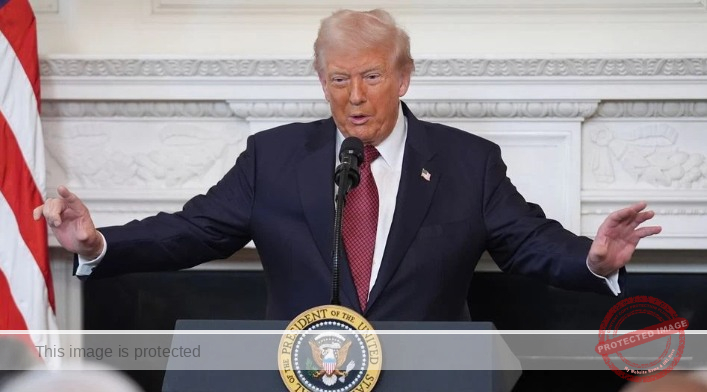
Washington, D.C. | November 2025 – Former President Donald Trump has announced a plan to provide $2,000 payments to all Americans, proposing that the funds will come from the tariff revenue collected by his administration. The announcement, made on his Truth Social platform, has sparked significant attention and debate regarding the future of U.S. economic policy.
What Happened?
In his social media post, Trump outlined a proposal to distribute a $2,000 “dividend” to every American, excluding high-income earners. The payment would be funded by the tariff revenues collected by the administration, with Trump calling those who oppose tariffs “fools.”
“A dividend of at least $2000 a person (not including high income people!) will be paid to everyone,” Trump wrote, adding that the revenue generated from tariffs could be used for the public’s benefit. The idea mirrors similar legislation introduced earlier this year by Republican Senator Josh Hawley (R-MO), who proposed giving $600 tariff rebates to nearly all Americans and their dependent children.
This proposal raises significant questions, as it would likely need to pass through Congress, where support for such measures remains uncertain. However, the idea has reignited discussions about the relationship between tariffs, government revenue, and direct payments to citizens.
Who Was Behind the Proposal?
The $2,000 dividend proposal comes directly from the former President, who has long been an advocate for tariffs as a means of strengthening the U.S. economy. Trump has consistently argued that tariffs are necessary to protect American industries and counter unfair trade practices from countries like China, Canada, Mexico, and the European Union.
In his Truth Social post, Trump reiterated his stance on the country’s economic standing, writing, “We are now the richest, most respected country in the world, with almost no inflation, and a record stock market price. 401k’s are highest EVER. We are taking in trillions of dollars and will soon begin paying down our ENORMOUS DEBT, $37 Trillion.” These claims aim to bolster his economic record, with the $2,000 payments positioned as another step in delivering direct benefits to American citizens.
The Tariff Revenue and Economic Impact
According to the U.S. Treasury Department, the administration has collected $195 billion in tariff revenue in the first three quarters of the year. This figure underscores the significant impact of the tariffs Trump has imposed on foreign trading partners.
In his proposal, Trump pointed out that the tariff revenue could be used to help address the country’s $38 trillion national debt, a priority highlighted by Treasury Secretary Scott Bessent earlier this year. Bessent has stated that the administration’s primary goal is to use tariff revenue to reduce the national debt, which has reached historically high levels.
Public and Political Reactions
Trump’s announcement has garnered both support and skepticism. While some supporters view the proposal as a much-needed direct payment to citizens, critics are questioning the feasibility of the plan, especially given the potential hurdles in securing Congressional approval.
Following Trump’s post, Bessent addressed the idea of stimulus payments, telling ABC News that while he had not spoken directly with Trump about the $2,000 checks, he emphasized that “stimulus can come in many forms.” Bessent’s comments suggest that while the administration is open to the idea of stimulus, the specifics remain uncertain.
What Happens Next?
While Trump’s plan has drawn significant attention, the proposal’s path to implementation is unclear. With the Supreme Court expressing skepticism about the legality of the president’s use of powers to impose tariffs, the future of Trump’s tariff-based initiatives remains uncertain.
As the debate continues, Trump’s proposal has sparked renewed discussion about the role of tariffs in funding public services and supporting economic relief programs. The push for direct payments will likely be a key issue in future political discussions, especially as the country continues to grapple with inflation and economic recovery in the wake of the pandemic.
Closing Thoughts
This story may be updated with more information as it becomes available.
