
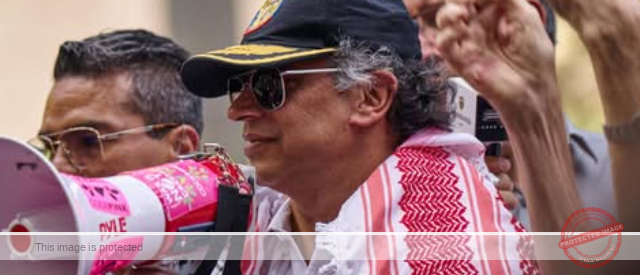
Washington, D.C. — The United States has revoked the visa of Colombian President Gustavo Petro after he made controversial remarks at a pro-Palestinian rally in New York. The State Department described his comments as “reckless and incendiary” and criticized Petro for urging U.S. soldiers to disobey orders from former President Donald Trump.
What Happened
Petro, who was in the U.S. for the United Nations General Assembly, made the remarks on Friday, September 22, 2025, during a rally where he called for the formation of a “world salvation army” with the primary mission to “liberate Palestine.” He urged U.S. soldiers not to follow orders from then-President Trump, saying, “Disobey Trump’s order! Obey the order of humanity!” Petro further called on young soldiers in Israel and the U.S. to turn their weapons away from humanity and focus on combating “tyrants and fascists.”
The US Response
In response to Petro’s comments, the State Department moved swiftly to revoke his U.S. visa, citing his actions as an incitement to violence. A spokesperson for the department condemned his call for U.S. soldiers to disobey orders, describing his behavior as “reckless and incendiary.”
Petro’s remarks, which were made in the context of a broader political rally, came after he called for a criminal inquiry into the Trump administration’s airstrikes targeting drug-trafficking boats in the Caribbean, operations that were part of a broader U.S. anti-drug initiative.
Colombian Government’s Reaction
As Petro was already on his way back to Bogotá when the U.S. announced the visa revocation, the Colombian government responded sharply. Interior Minister Armando Benedetti took to social media, criticizing the U.S. decision and defending Petro’s right to voice criticism. Benedetti suggested that Israeli Prime Minister Benjamin Netanyahu’s visa should have been revoked instead, calling it an act of hypocrisy by the U.S.
Tensions Between Petro and the US
The relationship between President Petro, who leads Colombia’s first-ever left-wing government, and the U.S. has become increasingly strained. Petro used his UN speech to condemn U.S. airstrikes on boats suspected of trafficking drugs. He accused U.S. officials of being aligned with drug gangs while Colombia’s government was working to curb coca farming. Petro also criticized what he described as U.S. “violence to dominate” Latin America, which he argued was masked under the guise of anti-drug operations.
In contrast, Washington maintains that these airstrikes were part of a legitimate anti-drug operation aimed at Venezuelan cartels, with the U.S. accusing Venezuelan President Nicolás Maduro of overseeing such illegal activities.
International Context
This visa revocation is part of a broader pattern of tensions between the U.S. and some global leaders. Alongside Petro, Palestinian President Mahmoud Abbas and 80 Palestinian officials were also denied visas to attend the UN General Assembly—a notable move given the convention typically permits world leaders to attend regardless of diplomatic relations.
What Happens Next
Petro’s visa revocation highlights the escalating friction between the U.S. and Colombia, particularly over the issues of drug trafficking, military engagement, and human rights. As the situation develops, it will likely continue to influence U.S.-Colombian relations, particularly in light of Petro’s ongoing critique of U.S. foreign policy in the region.
This story may be updated with more information as it becomes available.
