
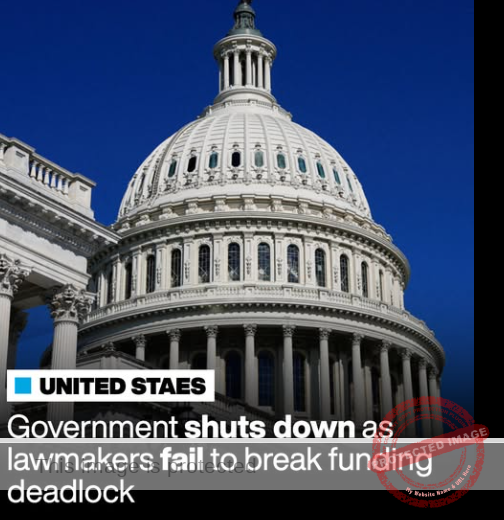
The U.S. government officially shut down at midnight on Wednesday after lawmakers and President Donald Trump failed to resolve a budget impasse. The shutdown, the first since the record-breaking 35-day closure in 2018-2019, will halt operations at various federal agencies and impact hundreds of thousands of government workers.
What Happened
The shutdown began after Senate efforts to pass a short-term funding resolution, which had already been approved by the House of Representatives, failed. Despite last-minute talks at the White House on Monday, no progress was made in breaking the deadlock. The gridlocked negotiations were particularly contentious over health care funding, with Democrats demanding the restoration of billions in health care spending, especially for the Affordable Care Act (Obamacare), which the Trump administration has sought to dismantle.
President Trump blamed Democrats for the failed talks, and threatened to target progressive priorities and push for public sector job cuts during the shutdown. He suggested that “a lot of good can come down from shutdowns” and hinted at using the pause to eliminate programs he described as “Democrat things.”
Impact on Federal Workers and Agencies
The shutdown is expected to affect up to 750,000 federal workers, with many being furloughed or working without pay until the deadlock is resolved. However, essential services, such as the Postal Service, military, Social Security, and food stamps, will continue without disruption. The shutdown will also not affect welfare programs or emergency services, but key departments will experience significant slowdowns.
Senate Gridlock and Political Tensions
The Senate’s inability to pass the funding bill, due to the requirement of a 60-vote majority, led to the closure. With Democrats controlling just seven votes in the Senate, and facing a Republican-controlled House, no compromise was reached in time for the midnight deadline. Senate Democrats objected to the seven-week stop-gap funding proposal, demanding more health care funding, which Republicans were unwilling to support.
Future of the Shutdown
It remains uncertain how long the shutdown will last. The Senate is expected to reconvene on Wednesday, but the House is on a recess this week, preventing any quick action to resolve the issue. Senators will return on Friday, with the possibility of continuing work over the weekend.
Historical Context
Since 1976, the U.S. government has shut down 21 times, with durations ranging from just a few hours to several weeks. The longest shutdown began in December 2018, when Trump and Democrats were unable to agree on funding for a border wall. That closure saw around 380,000 federal workers furloughed and 420,000 working without pay.
Closing Line:
This story may be updated with more information as it becomes available.
