
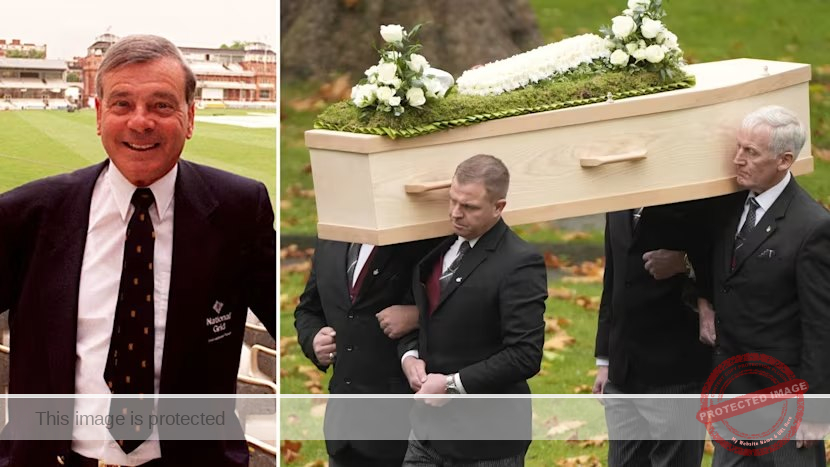
The funeral of cricket legend Dickie Bird OBE took place in his hometown of Barnsley, honoring the beloved former umpire who passed away at the age of 92 in September. Bird, widely regarded as one of the sport’s most cherished figures, left behind a legacy that transcended his role on the field. His funeral was held at St Mary’s Church, followed by a private cremation for close family members.
A Fond Farewell to a Cricket Icon
On the way to the church, Bird’s funeral procession made a brief stop outside his statue, a lasting tribute to the man who became a cricket icon. The moment was deeply emotional for those who had gathered to pay their respects. Among the mourners was Bird’s long-time friend and former teammate, Sir Geoffrey Boycott, who shared fond memories of their 70-year friendship.
Boycott recalled the first time he met Bird at the age of 15 while playing cricket for Hemsworth Grammar School. He spoke warmly of Bird’s character, highlighting his unique qualities: “Surprisingly with all the nerves he had as a batsman, he became a great umpire because he could channel all that nervous energy into good decisions.” Boycott fondly remembered how Bird had a way of making everyone feel special, saying, “It would be hard to find anyone who didn’t like him.”
A Man of the People
Colin Graves, Chair of Yorkshire County Cricket, delivered a heartfelt eulogy on behalf of Bird’s former club. Graves described Bird as “undoubtedly a man of the people,” emphasizing his connection with everyone at the club, from players to staff. “Dickie was one of the family,” Graves said. “He will be missed greatly but will never be forgotten.”
Graves went on to praise Bird’s warm, emotional nature and his sense of humor, saying he maintained his sharpness up until his passing. Bird was revered globally as an international umpire, known for his no-nonsense approach, often telling players to “cut it out and get on with it.”
A Legacy Remembered by Fans and Friends
Members of the public lined the streets near the church to show their respects. One of the first to arrive was cricket fan Russ Cowling, who had traveled nearly 50 miles from Goole to attend the service. He described Bird as “a gent” and “a gem,” recalling countless stories about the umpire, including his famous encounter with a bus conductor during the 1975 World Cup final, when Bird discovered the conductor was wearing the hat stolen from his head during the match.
A Career That Shaped Cricket
Born Harold Dennis Bird in Barnsley, Bird had a modest playing career with Yorkshire and Leicestershire before retiring at 32. In 1973, Bird made his umpiring debut in an international match, eventually overseeing 66 test matches and 69 one-day games, earning a reputation as one of the finest umpires in cricket history.
His legacy, both on and off the field, continues to resonate with fans and players alike. Bird’s deep love for the game and his dedication to it has left an indelible mark on cricket, and he will be fondly remembered by all who had the privilege of witnessing his impact.
Dickie Bird, a national and Yorkshire treasure, has left us, but his memory and legacy will live on forever.
