
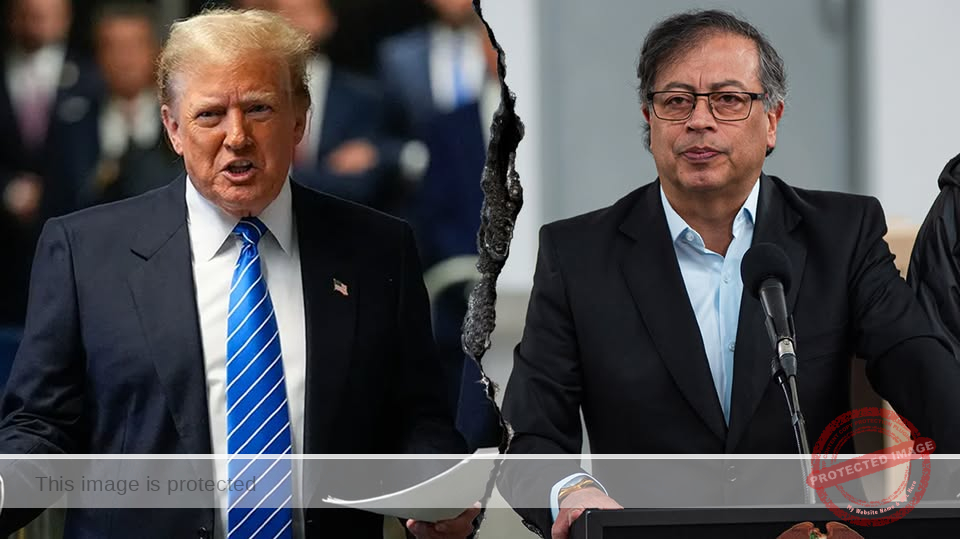
October 2025 – Washington, D.C. – President Donald Trump has escalated tensions with Colombia after calling the country’s far-left president, Gustavo Petro, a “lunatic” and “the worst president they’ve ever had.” In a series of comments made while speaking to reporters aboard Air Force One on Sunday, Trump reiterated his vow to cut all funding to Colombia and impose new tariffs, accusing the country of producing and refining cocaine rather than combating its trafficking.
What Happened: Trump’s Strong Words Against Petro and Colombia
Trump’s latest comments came amid growing frustrations with Colombia’s handling of the drug trade. The president claimed that Colombia has failed in its fight against narcotics, saying the country continues to produce drugs, including cocaine, instead of taking steps to curb the flow of illegal substances into the United States.
“They make drugs, they refine drugs, they make cocaine, they have cocaine factories,” Trump said. “They have no fight against drugs, and I’m stopping all payments to Colombia because they don’t have anything to do with their fight against drugs.” His remarks signal a significant deterioration in the relationship between the U.S. and one of its closest allies in Latin America.
Background on the Conflict: Petro’s Presidency and U.S.-Colombia Relations
Gustavo Petro, Colombia’s first leftist president, has been at odds with Trump for much of 2025, with tensions rising over a variety of issues. Petro rejected U.S. military flights of deported migrants, prompting Trump to threaten tariffs. He also clashed with the U.S. over military strikes on boats in the Caribbean, alleging that U.S. operations have led to civilian casualties, including the death of a Colombian fisherman.
Trump’s comments follow a growing sense of dissatisfaction with Colombia’s inability to curb coca cultivation, which reached an all-time high last year, according to the United Nations. While Colombia remains Washington’s top regional aid recipient, the amount of U.S. funding has decreased significantly, falling to $230 million in 2025, well below previous levels.
Career, Legacy, and Implications of the Ongoing Clash
Trump’s criticism of Petro and the threats of further cuts to U.S. aid reflect the broader strategy of his administration in dealing with Latin American countries. The U.S. has ramped up its efforts against narcotics trafficking across the Caribbean, deploying ships and surveillance aircraft as part of a broader crackdown on trafficking networks.
In addition to his economic threats, Trump authorized covert operations inside Venezuela, a country also under increasing pressure from the U.S. administration. However, Colombia remains a critical partner in the U.S. war on drugs, and the country’s failure to cooperate in the drug war has been a point of contention for years.
Public and Social Media Reactions
The growing tension between Trump and Petro has stirred reactions on both sides. Petro fired back against Trump’s accusations, calling his claims “distorted” and labeling the U.S. president’s comments as “rude and ignorant.” Petro defended his position, stating that promoting peace in Colombia is not equivalent to drug trafficking.
In a statement on X (formerly Twitter), Petro emphasized his efforts as the “main enemy” of drugs in Colombia, rejecting Trump’s characterizations. Colombian authorities also criticized Trump’s remarks, with the Colombian Foreign Ministry accusing him of making an “illegal intervention” in the country’s sovereignty.
Official Statements and What Happens Next
In response to Trump’s threats of tariffs and funding cuts, Colombian Defense Minister Pedro Sánchez reiterated the country’s commitment to fighting drug trafficking. He pointed out the sacrifices made by the Colombian armed forces in the ongoing battle against narcotics. The U.S. is closely monitoring the situation as both countries face mounting challenges in addressing the illegal drug trade.
With tensions now heightened, the possibility of new tariffs looms large, and the geopolitical landscape of U.S.-Colombian relations is entering a period of significant uncertainty. Further negotiations and diplomatic efforts may be required to address the fallout of these escalating tensions.
This story may be updated with more information as it becomes available.
