
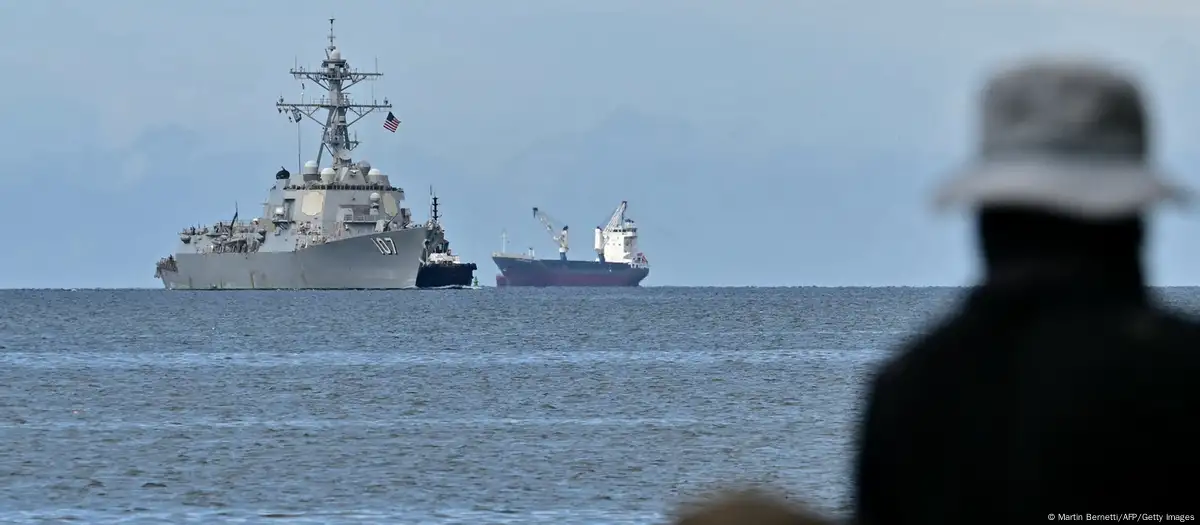
WASHINGTON, D.C. — The USS Gerald R. Ford, the world’s most expensive and advanced aircraft carrier, is heading to the Caribbean under orders from U.S. President Donald Trump in what experts describe as the most significant U.S. military deployment in the Western Hemisphere in a generation. The $13 billion warship, along with its escort fleet, is officially targeting international drug cartels — though growing speculation suggests the mission may have broader geopolitical motives.
What Happened
The USS Gerald R. Ford, measuring over 1,000 feet long and equipped with dozens of fighter jets and helicopters, was deployed in late October 2025 following Trump’s directive to the Department of Defense — now renamed the Department of War under Secretary Pete Hegseth.
The U.S. government claims the deployment is aimed at dismantling powerful drug cartels operating throughout the Caribbean and Latin America. Trump compared the cartels to the “IS of the Western Hemisphere,” emphasizing their transnational threat to U.S. security.
Since August 2025, U.S. operations in the region have reportedly killed dozens of suspected smugglers, although no concrete evidence has been released linking the victims to drug trafficking. Hegseth confirmed that four smuggling vessels were destroyed in the eastern Pacific, resulting in 14 deaths — sparking international outrage and questions over the legality of the strikes.
Despite these concerns, Congressional Republicans blocked a Democratic proposal to require legislative oversight before authorizing military action against cartels, effectively giving Trump full discretion over the campaign.
Background and Broader Context
Experts believe the military escalation in the Caribbean may have less to do with narcotics and more with the political crisis in Venezuela. The Trump administration has long accused Venezuelan President Nicolás Maduro of running a “drug cartel regime.” Washington refused to recognize his 2025 re-election, calling it fraudulent, and doubled the reward for information leading to his capture to $50 million — twice that once offered for Osama bin Laden.
Political analyst Christopher Hernandez-Roy of the Center for Strategic and International Studies told DW that the scale of the operation far exceeds previous anti-narcotics missions, suggesting a dual purpose: deterring smuggling while signaling U.S. readiness for further action in the region.
In early October, Trump reportedly approved a covert CIA operation in Venezuela, coinciding with military exercises near Trinidad and Tobago, just miles from Venezuelan waters. The developments have reignited fears of potential U.S. intervention aimed at regime change — echoing historical precedents such as the 1989 U.S. invasion of Panama.
Strategic and Political Implications
According to Sascha Lohmann from the German Institute for International and Security Affairs (SWP), the Caribbean buildup “clearly goes beyond a war on drugs.” He suggests that Trump’s motivations are partly political and economic, noting that Venezuela’s vast oil, gold, and mineral reserves make it a strategic interest for Washington.
Reports indicate that Trump rejected an offer from Maduro for preferential access to Venezuela’s resources, further straining relations. Lohmann argues that Trump’s supporters view the operation as a revival of the Monroe Doctrine, rebranded by some as “Monroe 2.0” or “Donroe” — a modern assertion of U.S. dominance in the Western Hemisphere.
“This isn’t about keeping foreign powers out anymore,” Lohmann said. “It’s about expanding U.S. influence — rewarding allies and punishing those who resist.”
Regional and International Reactions
Reactions from Latin America have been mixed and cautious. Maduro has denounced the U.S. military presence as a “grave threat to Caribbean peace,” claiming it represents “hostile provocation” and announcing Venezuelan coastal defense drills in response.
Meanwhile, the U.S. recently sanctioned Colombian President Gustavo Petro, accusing him of collaborating with narcotics traffickers — a move that further divided regional opinion.
Marcela Donadio, executive secretary of the Latin American Security and Defence Network (RESDAL), warned that an external intervention in Venezuela could destabilize the entire region. She urged leaders from Chile, Mexico, and Brazil to mediate diplomatically before tensions escalate.
“The internal consequences of a U.S.-backed intervention would be severe,” Donadio said. “No government installed by a foreign power can bring lasting peace.”
Public and Political Reactions in the U.S.
Within the U.S., reactions to Trump’s Caribbean military campaign have been sharply polarized. His supporters hail it as a bold defense of national security, while critics accuse him of using military power for political gain ahead of the 2026 election.
Trump, who has long expressed his desire to be seen as a “president of peace,” reportedly views decisive foreign action as a path toward global recognition — possibly even the Nobel Peace Prize.
However, experts caution that any escalation involving Venezuela could result in a prolonged conflict that undermines that image.
What Happens Next
The USS Gerald R. Ford strike group is expected to remain in the Caribbean for several months, conducting joint operations with regional allies. The Pentagon and Southern Command (SOUTHCOM) have not disclosed detailed operational timelines or targets.
International observers are closely watching whether the mission remains limited to anti-drug enforcement — or evolves into a direct confrontation with Venezuela.
For now, Latin American leaders are calling for diplomacy over aggression, while U.S. allies prepare for the potential political fallout of what could become one of the most consequential U.S. military deployments of the decade.
This story may be updated with more information as it becomes available.
