
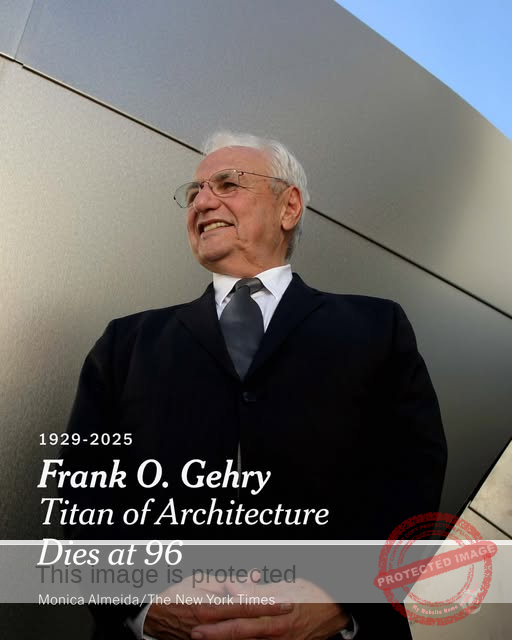
SANTA MONICA, CALIFORNIA — World-renowned Canadian-American architect Frank Gehry has died at the age of 96, passing away peacefully on Friday, December 5, 2025, at his home in Santa Monica, California, following a short battle with a respiratory illness. His death marks the end of an era in global architecture and design.
Best known for reshaping skylines and redefining how buildings interact with culture, movement, and emotion, Frank Gehry’s passing has prompted tributes from architects, artists, city leaders, and admirers around the world.
What Happened
According to family sources, Frank Gehry died on December 5, 2025, surrounded by loved ones at his Santa Monica residence. He had been experiencing complications related to a respiratory illness but remained engaged with his work and legacy until his final days.
News of his death spread quickly across international media, with institutions, universities, and cultural organizations honoring his extraordinary influence on modern architecture.
Who Was Frank Gehry
Born Frank Owen Goldberg in Toronto, Canada, in 1929, Gehry later emigrated to the United States and became one of the most influential architects of the 20th and 21st centuries. After studying architecture at the University of Southern California and urban planning at Harvard University, he established his practice in Los Angeles.
Over a career spanning more than six decades, Frank Gehry became synonymous with deconstructivist architecture, rejecting rigid modernist conventions in favor of expressive, sculptural forms that blurred the line between art and building.
Career, Legacy, and Architectural Impact
Frank Gehry’s legacy is inseparable from his groundbreaking works. His design of the Guggenheim Museum Bilbao (1997) in Spain redefined the role of architecture in urban renewal. The building’s flowing titanium curves sparked what is now known as the “Bilbao Effect,” demonstrating how a single landmark can economically and culturally transform an entire city.
In the United States, Gehry left an enduring mark with the Walt Disney Concert Hall in Los Angeles, a cultural icon admired for both its acoustics and dynamic stainless-steel exterior. Internationally, projects such as the Louis Vuitton Foundation in Paris further cemented his reputation as an architectural visionary.
He was equally influential in challenging architectural norms closer to home. His redesigned Santa Monica residence, clad in unconventional materials, became a defining statement on reimagining the ordinary.
Gehry received numerous honors, including the Pritzker Architecture Prize in 1989, widely considered architecture’s highest achievement.
Public and Global Reactions
Following confirmation of Frank Gehry’s death, tributes flooded social media and professional circles. Architects described him as a “fearless innovator,” while cultural leaders praised his ability to translate emotion into physical space.
Universities, museums, and design institutions worldwide shared statements recognizing his profound influence on architecture, urban identity, and artistic freedom. Many credited Gehry with inspiring generations to think more boldly about form, space, and imagination.
Official Statements and What Happens Next
Gehry is survived by his wife, Berta Isabel Aguilera, their three children, and countless students, collaborators, and admirers across the globe. The family has requested privacy as they mourn.
Details regarding memorial services or public tributes are expected to be announced by the family and affiliated cultural institutions in the coming days. Several museums and architecture schools have already indicated plans to honor his life and work.
Frank Gehry’s death closes a monumental chapter in architectural history, but his influence will endure through the cities he reshaped, the ideas he challenged, and the generations he inspired. His buildings remain living testaments to imagination, risk, and the belief that architecture can move the human spirit.
This story may be updated with more information as it becomes available.
